Posts By: Daniel Midson-Short

AC Repair in Costa Mesa: Get Fast Help When Summer Heat Hits


It always happens at the worst time. The Costa Mesa afternoon hits 90 degrees. You walk inside expecting relief. The house feels like an oven.

You check the thermostat. The AC is running. The air coming out of the vents is warm.

That moment of panic is real. You start doing the math on a repair bill you didn’t plan for. You wonder how long your family has to sweat it out.

Most AC breakdowns aren’t random. They build slowly through spring. A low refrigerant charge. A tired capacitor. A clogged drain line that finally gives up.

By the time the heat arrives, your AC unit is running on borrowed time. Then it stops.

The good news is that most summer breakdowns are fixable, often same-day.

In this article, we’ll explore what causes these failures and what repairs cost. We’ll also show you how to find fast help.

Why COSTA MEsa AC Units Break Down in Summer

Heat is the trigger, not the cause. Your AC works hardest in July and August. That extra strain exposes weak parts that limped through spring.

A few failures show up again and again in Costa Mesa homes:

  • A failed capacitor. This small part starts the compressor. Heat wears it out fast, and the AC stops cooling.
  • Low refrigerant from a slow leak. Your system blows warm air and the outdoor coil can freeze over.
  • A clogged condensate drain line. Water backs up, the safety switch trips, and the AC shuts off.
  • A worn compressor. Years of run time and skipped maintenance take their toll.

Heat also raises the stakes. According to the CDC, heat is the leading weather-related cause of death in the United States. The National Weather Service warns that indoor heat is especially dangerous for kids, older adults, and pets.

A broken AC isn’t just uncomfortable. During a heat wave, it’s a real safety issue.

Coastal Costa Mesa adds its own twist. Salt-laced ocean air corrodes outdoor components faster than inland conditions. That corrosion eats at electrical contacts and coil fins over time.

So a system that would last 15 years inland might show trouble sooner here. Local wear patterns are part of why repairs cluster in the summer months.

What AC Repair Costs and How Long It Takes

Here’s the part most homeowners want to know first: the price.

A typical AC repair in Costa Mesa runs $150 to $800. Simple fixes are at the low end. A capacitor swap or drain clearing often costs $150 to $400 and takes under an hour.

Bigger AC repairs such as a refrigerant leak repair runs $400 to $1,500 depending on the leak. A failed AC compressor is the priciest fix, often $1,200 to $2,800.

Most repairs wrap up in a single visit. A licensed technician diagnoses the problem, confirms the price with you, and gets your home cool again the same day.

When you call Thomson Air Conditioning, you get a clear diagnosis and an honest quote before any work starts. No surprises on the bill.

There’s a smarter long game too. The U.S. Department of Energy reports that a well-maintained AC keeps its efficiency and lasts years longer. A small repair caught early often prevents a full replacement later.

The order of the bill matters too. Diagnosis fees usually run $75 to $150, and a good company rolls that into the repair cost. Ask before you book.

Watch out for flat-rate quotes given over the phone. No honest technician prices a compressor without seeing your system first.

How to Get Fast AC Help in Costa Mesa

Speed matters when your home is heating up. Here’s how to handle a breakdown without making it worse.

First, shut the system off if you see ice on the outdoor unit or smell burning. Running a frozen or overheating AC causes more damage.

Next, check the simple stuff. A tripped breaker or a packed air filter sometimes solves the problem in two minutes. A clogged filter starves the system of airflow.

If that doesn’t fix it, call a professional. The Department of Energy recommends professional service for any refrigerant, electrical, or compressor issue.

This is where local HVAC experience matters. A Costa Mesa company knows that coastal adjacent AC systems and the salt-air corrosion that wears them down faster. Our residential HVAC team handles repairs across the area, including same-day calls during heat waves.

Don’t wait days for relief. The longer a broken AC sits, the hotter your home gets and the more a small problem can grow.

While you wait for the technician, stay cool safely. Close blinds against the afternoon sun. Run fans to keep air moving. Drink plenty of water.

Get Your AC Running Again Today


A summer AC breakdown in Costa Mesa feels like an emergency because it is one. Warm air, a hot house, and a repair bill you didn’t expect add up to a stressful day.

The fix is usually simpler than you fear. Most repairs cost a few hundred dollars and finish in a single visit. The key is acting fast before the problem spreads.

Has your AC quit in Costa Mesa or across Orange County? Thomson Air Conditioning is ready to help. Our licensed technicians have served the local Costa Mesa area for years.

We know how to get coastal systems cool again fast.


Call Thomson AC at (562) 373-2386 or reach out to us online to book your AC repair today. Beat the heat, and get your Costa Mesa home comfortable again fast.

A Smart Guide to Air Conditioning Installation in Seal Beach

Your air conditioner in Seal Beach has worked hard for years. Now it feels like it’s limping through summer. It feels hotter inside than outside. Your energy bills climb every month. Your AC unit cycles on and off without cooling much.

Maybe an HVAC tech told you the compressor is already shot. Or the refrigerant is leaking faster than they can recharge it.

At some point, the math no longer works to continue doing AC repairs. When you are considering the cost of a new AC installation, the choices can feel confusing.

Which size AC unit? Which AC unit brand? Which efficiency rating?

Many homeowners get stuck in decision fatigue and end up waiting, figuring they can suffer through one more summer with a failing system.

The cost of waiting for an AC replacement adds up fast. The U.S. Department of Energy confirms that older AC units use 30 to 50% more energy than modern high-efficiency systems.

In this article, we’ll cover everything you need to know about air conditioning installation in Seal Beach. We’ll explain how to size your system, what costs to expect, and how to find local help.

What Drives AC Installation Decisions in Seal Beach

Seal Beach homes have specific cooling needs. Coastal homes near Main Street and the Pacific Coast Highway enjoy mild summers most years, while inland areas like College Park East and The Hill see hotter peaks. That climate variety changes which AC system fits your home best.

New federal regulations also shape your options. The Department of Energy confirms all new central AC units sold after January 2023 must meet SEER2 efficiency standards, so older SEER ratings no longer apply. For Seal Beach homes, the minimum SEER2 rating is 14.3, though higher-efficiency units offer 16, 18, or even 22. The higher the rating, the lower your monthly bill.

Common AC installation choices include:

  • Central split systems for whole-home cooling
  • Heat pumps that provide both cooling and heating
  • Ductless mini-splits for additions, garages, or zoned rooms
  • High-efficiency variable-speed units for maximum savings

Sizing matters more than most homeowners realize. An oversized unit cycles on and off, wears out faster, and creates humidity problems, while an undersized unit runs constantly without ever keeping up. That is why pros use a Manual J calculation to size your system, factoring in square footage, insulation, windows, ceiling height, and sun exposure. A 1,500-square-foot home in Seal Beach typically needs a 2- to 3-ton system.

Incentives can also affect the decision. The federal heat pump tax credit (25C) ended for systems installed after 2025. South Coast AQMD’s GO ZERO heat pump rebate is expected to reopen; ask us whether your system would qualify.

One myth costs Seal Beach homeowners thousands: the belief that bigger AC units cool better. They do not. Right-sized units always outperform oversized ones for comfort, efficiency, and lifespan.

How to Plan Your AC Installation


A smooth AC installation in Seal Beach starts with the right contractor. Begin with a free in-home consultation, where a pro will inspect your existing ductwork, measure your rooms, and check your electrical panel before recommending equipment based on your home’s specs and your budget.

Look for these signs of quality:

  • California C-20 HVAC license from the state board
  • Manual J load calculation for proper sizing
  • Written estimates with brand, model, and SEER2 rating listed
  • Trained, licensed installers who know current codes
  • Manufacturer warranties on parts and labor

Installation costs in Seal Beach vary by system. Standard central AC installations average $5,500 to $9,500, while high-efficiency systems run $8,000 to $13,000. Heat pump installations cost $7,000 to $15,000, and ductless mini-split systems start around $4,500 for single zones.

The full process usually takes one to three days. The crew removes the old equipment, installs the new components, runs new refrigerant lines, and tests the system before they leave.

Permits matter too. The City of Seal Beach requires HVAC permits for all installations, and quality contractors handle that paperwork for you. Skip the permit, and you will run into problems when you sell your home later.

Thomson AC handles air conditioning installation across Seal Beach, Old Town, College Park East, and Bridgeport. Visit our Seal Beach services page to see our full coverage area. Our team installs Carrier, Trane, Lennox, and other top brands, and we pull permits, handle inspections, and back our work with strong warranties.

We also offer financing options, and most Seal Beach homeowners qualify for low monthly payments on a new system.

After installation, our maintenance plans keep your new system running at peak efficiency. Plan members enjoy yearly tune-ups, priority scheduling, and lower long-term costs.

Timing your installation matters in Seal Beach as well. Spring and fall offer the best scheduling and the cleanest install conditions. Summer installs still happen fast, but contractor calendars fill quickly with repair calls.

The EPA confirms that high-efficiency AC systems can cut cooling costs by up to 20% compared to older units. On a typical Seal Beach home, that adds up to $300 or more in yearly savings.

Smart-thermostat integration adds even more value. Modern systems pair with Wi-Fi thermostats that learn your schedule and adjust cooling on their own, which protects your investment and lowers your monthly bills at the same time.

Get a New AC System Built for Seal Beach

Air conditioning installation in Seal Beach comes down to the right contractor, the right size, and the right system. New systems deliver real savings: lower bills, better comfort, and fewer breakdowns, and modern equipment lasts longer and runs cleaner than older units.

Thomson AC handles AC installations throughout Seal Beach, and our certified team handles sizing, equipment selection, permits, and the full installation. Stop fighting an old AC system that cannot keep up.

Call (562) 373-2386 to schedule your free consultation. You can also visit our contact page for an online quote. Your new comfort starts here.

How to Choose Reliable HVAC Service in Huntington Beach

Your home in Huntington Beach should feel like a coastal retreat. Cool, calm, and comfortable.

But when summer hits and the marine layer burns off by 11am, indoor temps climb past 80 degrees.

Your AC unit hums away, but the airflow feels weak. Rooms upstairs stay warm even with the system running.

Sound familiar?

When Your Coastal Comfort Slips Away

The problem usually points to one thing. Your HVAC system in Huntington Beach can’t keep up with the unique demands of coastal Orange County living.

Salt air accelerates corrosion on outdoor condenser coils. Marine humidity strains evaporator components.

Old AC units lose efficiency every year they run without service.

Many homeowners chase quick fixes. They call the cheapest contractor or skip seasonal tune-ups.

The result? Higher bills, repeat breakdowns, and shorter equipment life.

In this article, we’ll explore how to choose dependable HVAC service in Huntington Beach. You’ll see what matters in a contractor, and how Thomson AC can help if you need a hand.

Why Huntington Beach Homes Demand Specialized HVAC Care

Huntington Beach sits on the Pacific Coast. Salt air drifts inland from Sunset Beach and Bolsa Chica every day.

That coastal exposure changes everything for your HVAC unit. Sea salt settles on outdoor equipment and works on the aluminum fins and copper tubing over time.

Add the daily marine layer. Mornings in Huntington Harbour and other neighborhoods near the water are often damp and humid.

That moisture makes your AC work harder and wears on its parts.

The local climate also creates wide temperature swings. Coastal mornings can be cool while inland afternoons get hot.

Your HVAC system runs through every weather pattern Southern California sends.

Without regular care, that coastal wear adds up, and equipment near the beach can need repairs or replacement sooner than it should.

Common myths cost homeowners money. Two big ones to skip:

  • “Newer units don’t need maintenance.” False. Even new systems lose efficiency without yearly tune-ups.
  • “All HVAC contractors are the same.” False. Coastal HVAC requires specific training and parts knowledge.

The right contractor saves you money long term. The wrong one costs you your equipment.

How to Choose the Right HVAC Service Provider

Choosing reliable HVAC service in Huntington Beach takes a few smart steps.

Start with the basics. Verify the contractor holds a current California C-20 HVAC license. Check it through the California Contractors State License Board.

Next, ask about coastal experience. Any local pro should know how salt air affects condenser coils.

They should recommend protective coatings or stainless steel hardware.

Look for these signs of a quality HVAC company:

  • Trained, licensed technicians who know modern systems
  • Written estimates before any work begins
  • Local references from Huntington Beach customers
  • Clear communication about when they can come out and what happens next
  • Manufacturer-approved parts instead of generic substitutes

Pricing matters too. A good contractor explains the problem and gives you a clear price before any work starts, so you can decide without pressure.

Ask what a tune-up includes versus a full maintenance visit, and how repair and replacement quotes are put together.

Regular maintenance is the smart middle ground. Catching wear early is almost always cheaper than waiting for a breakdown.

Indoor air quality also matters in coastal homes.

Salt and sand particles enter through windows and doors. Standard filters miss the smallest particles.

A pleated MERV 11 filter or HEPA-grade air cleaner makes a big difference for allergy-prone families.

Quality contractors should offer indoor air quality assessments alongside HVAC service.

Skipping maintenance feels like savings at first. But small problems that go unchecked can turn into bigger, more expensive repairs.

Thomson AC offers full coverage for Huntington Beach homes. Visit our HVAC maintenance in Huntington Beach page to see what we cover.

We carry parts for every major brand. Our technicians know how to spot coastal corrosion early.

That saves you money on premature replacements.

We also offer maintenance plans for homeowners who want regular care on the calendar.

Need service? Call us or Text us at 201-3014 and we’ll get you on the schedule.

A solid maintenance visit covers the basics most homeowners skip.

The technician cleans condenser coils, checks refrigerant pressure, tests electrical connections, and lubricates motor bearings.

They also test airflow at every register and inspect the condensate drain for clogs.

Each step helps your system run better and last longer.

Skip maintenance, and efficiency slowly slips. That gap shows up in your monthly bill.

Heating Season HVAC Service in Huntington Beach

Huntington Beach winters are mild, but the nights still get cold, especially near the water when the marine layer rolls in. Most furnaces here sit unused from spring to fall. The first time you turn the heat on, dust has built up and small problems haven’t shown themselves yet.

Furnace repair. If your furnace won’t light, shuts off after a few minutes, blows cold air or makes a new noise, we’ll find the cause and explain it before any work starts. You get a clear price up front, and you decide. Learn more on our furnace repair page.

Heater tune-up ($99). A tune-up is a quick, inspection-based visit. We check that your furnace starts and runs safely, look for obvious problems and change your filter. It’s a good fit if your system is fairly new and running well.

Maintenance visit ($159). A maintenance visit goes further. We do a detailed, component-by-component inspection and, for heating season, flush the drain line and clean the flame sensor. A dirty flame sensor is one of the most common reasons a furnace lights and then shuts off. See what’s included on our HVAC maintenance in Huntington Beach page.

Not sure which one you need? Tell us your system’s age and how it’s been running, and we’ll give you a straight answer. For everything we do in winter, visit our heating services page.

Call us or Text us at 201-3014 for service or a Free Estimate. Financing is available through Goodleap.

Get Huntington Beach HVAC Help When You Need It

Reliable HVAC service in Huntington Beach comes down to three things.

The right contractor, regular maintenance, and quick action when problems start.

Coastal homes face conditions inland HVAC units never see. Salt air, marine humidity, and wide temperature swings stress your system.

The fix? Work with a contractor who understands the local environment. Schedule yearly tune-ups. Address small issues before they grow.

Thomson AC handles HVAC service across Huntington Beach, Sunset Beach, and Huntington Harbour.

Our technicians know the area, the climate, and what your system needs.

Call us at (562) 201-3014 or Text us to schedule service. Or use Free Estimate to book online. Your comfort matters, and we’re ready to help.

FAQ

How do I choose reliable HVAC service in Huntington Beach?

Start with a current California C-20 HVAC license (check CSLB). Ask about coastal experience with salt air and marine humidity, and look for clear maintenance plans and honest options.

Why do Huntington Beach homes need specialized HVAC care?

Salt air accelerates corrosion on outdoor equipment, and marine humidity plus temperature swings stress systems. Coastal-specific care helps equipment last longer.

What areas does Thomson AC cover for HVAC service?

Thomson AC handles HVAC service across Huntington Beach, Sunset Beach, and Huntington Harbour. Call us or text us at (562) 201-3014, or use Free Estimate.

What’s the difference between a heater tune-up and a maintenance visit?

A tune-up ($99) is a quick, inspection-based visit with a filter change. A maintenance visit ($159) adds a detailed component-by-component inspection, and for heating season a drain line flush and flame sensor cleaning.

Do you repair furnaces in Huntington Beach?

Yes. We diagnose and repair furnaces throughout Huntington Beach and nearby cities, and we explain the problem and the price before any work starts. Call us or text us at 201-3014.

How Much Does AC Replacement Cost in Huntington Beach? Real Numbers for 2026

Your AC just stopped cooling. You called an AC repair tech, who says the compressor is dead, the refrigerant lines are corroded, and your system is fifteen years old. He suggests it it might be easier to and less expensive to replace.

So you ask: “How much is this going to cost?”

Most homeowners walk into AC replacement with no real benchmark. You hear quotes ranging from $5,000 to $18,000 from different contractors. None of them explains why.

That price gap isn’t random. It comes from real differences in equipment, the scope of installation, and what’s already in your home. In this article, we’ll break down what AC replacement actually costs in Huntington Beach in 2026, what drives the price, and how to make sure you don’t overpay.

What AC Replacement Costs in 2026

In the Huntington Beach market, full AC replacement for a single-family home runs $7,000 to $14,000 in 2026. Most homeowners land in the $9,000 to $11,000 range.

That’s a wide spread. Here’s what you get at each end.

Entry tier ($7,000 to $8,500): A 14 SEER2 single-stage system from a budget brand. Reliable, but limited efficiency and a 5 to 10-year warranty. Fine for smaller homes or rental properties.

Mid tier ($9,000 to $11,500): A 16 to 17 SEER2 two-stage system from a name-brand maker (Carrier, Trane, Lennox, Daikin). Quieter, more efficient, and warrantied 10 years on parts.

Premium tier ($12,000 to $14,000+): An 18 to 20+ SEER2 variable-speed system. Best comfort, lowest energy bills, longest warranty. Worth it for larger homes or homeowners staying 10+ years.

Heat pumps cost about 10% more upfront. The federal heat pump tax credit (25C) ended for systems installed after 2025. South Coast AQMD’s GO ZERO heat pump rebate is expected to reopen; ask us whether your system would qualify. They handle both heating and cooling, which can replace an aging furnace at the same time.

What’s Actually Driving the Price of an HVAC System

The unit itself is only about 50% of your final invoice. The rest is installation and what’s specific to your home.

Here’s where the dollars go:

  • Equipment. The condenser, air handler or coil, and refrigerant lines.
  • Labor. Two technicians, one day on most jobs.
  • Permits and inspection. California requires permitted HVAC work. Most contractors include this in the quote.
  • Refrigerant. Newer systems use R-454B. Charging the system is part of the cost.
  • Disposal. Hauling away the old unit and recycling refrigerant.
  • Ductwork repairs. If your existing ducts leak or are undersized, fixing them adds $1,500 to $4,000.
  • Electrical upgrades. Older homes sometimes need a new breaker or whip. Add $200 to $600.

The big variables are ductwork and electrical. A straightforward swap with healthy ducts comes in lower. A home with original 1970s ductwork needs more work, and the quote reflects that.

Why HVAC Replacement CostS HaVE Climbed

If you replaced your AC five years ago, today’s prices feel high. There’s a reason.

The U.S. Department of Energy raised minimum efficiency standards twice since 2023, pushing manufacturers to redesign equipment. New refrigerants like R-454B replaced the older R-410A, adding cost to every system.

Labor costs are up about 12% across the trades since 2022, per the Bureau of Labor Statistics. HVAC technicians are in short supply, and that pricing pressure flows to homeowners.

The good news is the new systems are dramatically more efficient. A 2026 mid-tier AC uses 30 to 40% less electricity than the equivalent 2015 system. Over 15 years, that gap covers a meaningful portion of the upfront cost.

How to Avoid Overpaying

The biggest mistake homeowners make is treating AC replacement like buying a refrigerator. It’s not. The system is custom-fit to your house.

Here’s how to keep the quote honest.

Get three written estimates. Anyone refusing to put numbers in writing isn’t worth your time.

Confirm the SEER2 rating, brand, model, and warranty in writing. Verbal promises don’t hold up after the install.

Ask what’s included. Permits, disposal, refrigerant, and a startup test should all be standard. If they’re not, the headline price is misleading.

Ask about rebates. Southern California Edison and SoCalGas both offer HVAC rebates that can knock $500 to $2,500 off a qualifying system. A good contractor knows which ones apply to your install.

Skip cash-only deals and same-day pressure. Real contractors give you time to think. Anyone pushing you to sign on the spot is hiding something.

When Replacement Beats Repair

A repair-or-replace decision usually comes down to one number. If the repair quote is more than half the cost of a new system and the unit is over 10 years old, replacement wins.

The ENERGY STAR rule of thumb says: multiply the repair cost by the system’s age in years. If the result is over $5,000, replace.

There’s also the efficiency angle. A 12-year-old AC running at 13 SEER costs about $400 more per year to operate than a new 17 SEER2 unit. That’s $4,000 over the next decade, before you factor in repair bills.

Our team can run that math with you on a free in-home quote. We’ll show you the actual numbers for your specific system, not a generic chart.

Get a Real Quote, Not a Guess


The only way to know your exact AC replacement cost is with a professional in-home assessment.

That way you are not missing the variables that matter most: ductwork condition, electrical capacity, and how your home’s layout affects the right system size.

If you’re in Huntington Beach, Seal Beach, or the surrounding Orange County area, Thomson Air Conditioning has installed thousands of systems in homes like yours. We give straight quotes with no surprise charges, walk you through every line item, and stand behind every install.

Call (562) 373-2386 or visit our contact page for a free Huntington Beach AC replacement quote. You’ll get a clear number, a transparent breakdown, and zero pressure to decide on the spot.

Heater Tune-Up & Maintenance in Huntington Beach

Thomson AC / Huntington Beach

Get your heater ready before the first cold night

Most Huntington Beach heaters sit unused all summer. Fall is a good time to have us look at yours, and at your air conditioning too.

We offer two different visits: a quick tune-up and a full maintenance visit. Here’s how they compare, so you can pick the one that fits your home.

Furnace maintenance with Glen▶ Watch video: Furnace maintenance with Glen

Tune-up vs. maintenance visit

Two visits, two levels of detail

Not sure which one you need? Call or text us and tell us about your system. We’ll help you choose.

Have more than one system in your home? Ask about multi-system discounts.

HVAC drain line explained▶ Watch video: HVAC drain line explained

Heating and cooling

What a maintenance visit covers

Heating, as it applies to your system: burners, ignition and safety controls, the heat exchanger or heating elements, the flue and venting, flame sensor cleaning, the gas valve, temperature rise and airflow.

Cooling, as it applies to your system: the air filter, condensate drain line flush, indoor and outdoor coils, refrigerant pressures and operating readings, electrical controls, fan components and visible equipment condition.

Whole system: thermostat, blower assembly, airflow, wiring and connections, unusual noise or odor, and system operation.

Not every task applies to every system, so we confirm the scope for your equipment before we start.

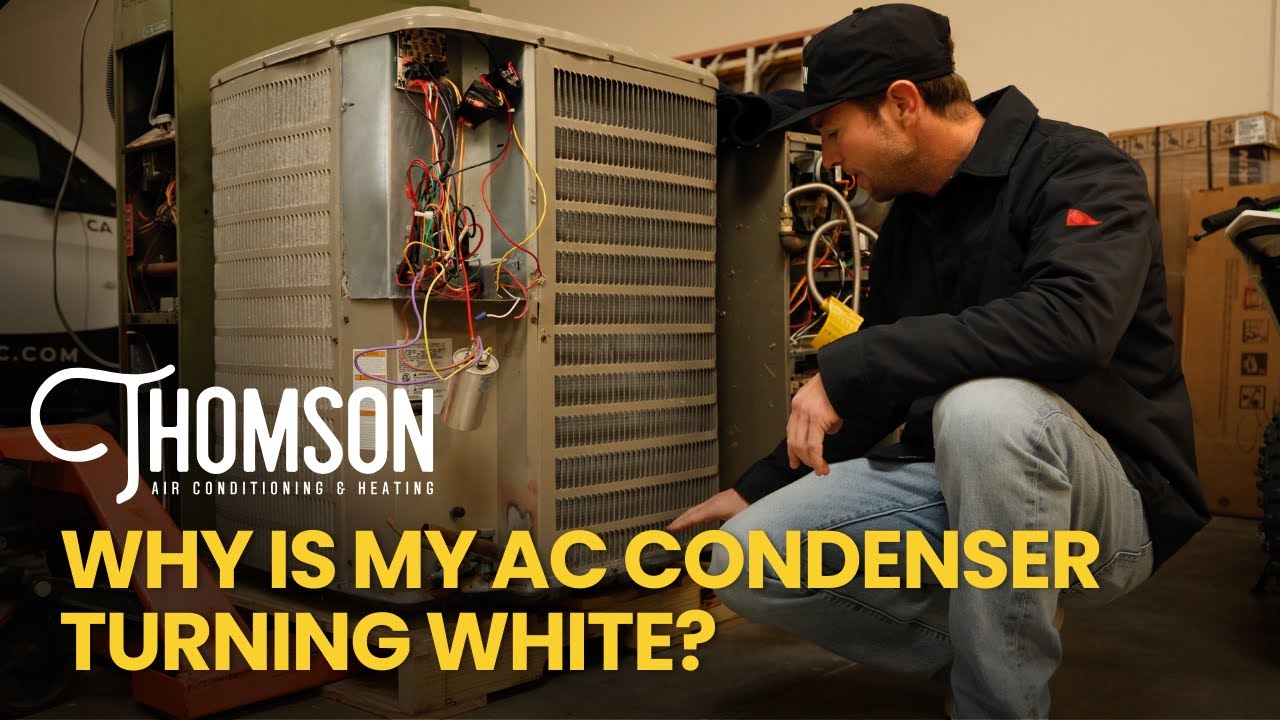
White buildup on your AC condenser▶ Watch video: White buildup on your AC condenser
Smelly furnace at first startup?▶ Watch video: Smelly furnace at first startup?

Signs your heater needs service

  • A burning smell that doesn’t fade after the first run of the season
  • The heater clicks or tries to start but won’t stay on
  • It turns on and off more often than it used to
  • Some rooms stay cold, or the airflow feels weak
  • New banging, squealing or rattling noises

If your carbon monoxide alarm goes off or you smell gas, leave the house and call 911 and your gas company from outside.

A Thomson technician reviewing photos of the system with a homeowner

Every maintenance visit is documented

  1. Listen.
    We start with your comfort concerns, thermostat settings and anything you’ve noticed.
  2. Inspect.
    We go through the heating and cooling components that apply to your system.
  3. Document.
    We take photos and short videos of equipment condition, readings and anything that needs attention.
  4. Explain.
    We review what we found in plain English before you decide on any additional work.
How we document maintenance visits▶ Watch video: How we document maintenance visits
3 reasons HVAC maintenance saves you money▶ Watch video: 3 reasons HVAC maintenance saves you money

Residential maintenance plan

Keep maintenance on the calendar

Our residential maintenance plan keeps your heating and cooling maintenance on a regular schedule, and we reach out to help arrange your visits so they don’t get forgotten.

  • Priority scheduling for plan members
  • Repair discounts
  • Certain plans include credits toward a future system replacement
  • More than one system? Ask about multi-system discounts.

Benefits and terms vary by plan. We explain what’s included before you enroll.

A Thomson technician inspecting a home furnace

Tune-up and maintenance questions

What’s the difference between a tune-up and a maintenance visit?

A tune-up is a quick, inspection-based visit with a filter change. A maintenance visit goes further: a much more detailed inspection of each component of your system, plus a condensate drain line flush and, for heating season, a flame sensor cleaning.

Which one should I book?

Call or text us at (562) 201-3014 and tell us about your system. We’ll help you choose between a tune-up and a maintenance visit.

Do you service both heating and air conditioning?

Yes. We cover the heating and cooling equipment that applies to your home, including furnaces, air conditioners and heat pumps. Not every task applies to every system, so we confirm the scope for your equipment.

Will I see what you found?

Yes. On maintenance visits we use photos and short videos to show equipment condition, readings and anything that needs attention, and we explain our findings in plain English before any additional work.

How much does a heater tune-up or maintenance visit cost?

A tune-up is $99 and a maintenance visit is $159. Call or text us at (562) 201-3014 and we’ll help you choose the right visit for your system. If your home has more than one system, ask about multi-system discounts.

Do you have a maintenance plan?

Yes. Our residential maintenance plan keeps heating and cooling maintenance on the calendar. Plan members receive priority scheduling and repair discounts, and certain plans include credits toward a future system replacement. Benefits and terms vary by plan, and we explain what’s included before you enroll.

My heater smells like burning when I first turn it on. Is that normal?

A short burning-dust smell the first time a heater runs after summer is common. If it doesn’t fade quickly, or it smells electrical or like gas, turn the system off and call us.

Do you serve my area?

Yes. We serve Huntington Beach, Seal Beach, Newport Beach and nearby coastal Orange County communities. Call us or text us at (562) 201-3014.

A Thomson technician beside the company service van

Book your fall visit

We take care of heating and cooling systems in Huntington Beach, Seal Beach, Newport Beach and nearby coastal Orange County communities. Need a repair or replacement quote instead? Ask for a Free Estimate.

AC Repair in Huntington Beach: What Often Goes Wrong and How To Fix It Fast

Whenever the temperature climbs above 80 degrees in Huntington Beach, most people will kick on their air conditioner. However, for many people, their system doesn’t seem to be running properly.

For some people, warm air is blowing from the vents, while others smell a musty or damp odor.

A failing Huntington Beach AC system is more than an inconvenience. It means sleepless nights and rising energy bills during the hottest months of the year.

You already pay enough to live in California; at the very least, you shouldn’t have to be sweating too!

Most AC failures come from a handful of causes. Low refrigerant, a dead capacitor, a frozen coil, or a worn-out compressor.

These problems get expensive fast. A small leak today becomes a compressor failure next month.

Your home’s humidity rises too. A struggling AC can’t properly remove moisture from the air.

The good news? Most AC problems are fixable. The key is to catch them early, before the damage spreads.

In this article, we’ll cover why AC units fail in Huntington Beach. We’ll break down repair costs. And we’ll show you where to find help.

Why AC Units Fail in Huntington Beach

Huntington Beach sits right on the Pacific Coast. That ocean breeze feels great on your skin.

But it’s rough on your AC equipment.

Salt air corrodes the metal fins on your outdoor AC condenser. Over time, that corrosion restricts airflow and forces the compressor to overwork.

The U.S. Department of Energy reports that AC makes up about 12% of home energy costs nationwide.

In coastal Southern California, that number climbs higher. Your AC runs harder and longer than inland systems.

Here’s what typically goes wrong with Huntington Beach AC systems:

  • Refrigerant leaks at corroded connections cut cooling capacity in half
  • Condenser coils coated in salt and sand overheat the compressor
  • Capacitors burn out from constant cycling during hot stretches
  • Clogged condensate drain lines trigger automatic safety shutoffs


Neighborhoods like Downtown, Seacliff, and Huntington Harbor sit just miles from the coast. Every Huntington Beach AC system experiences faster AC wear due to marine air.

Homes near Beach Boulevard and Edinger Avenue face the same issue. Marine air doesn’t stop at the sand.

If your AC unit is over 10 years old, hidden problems are slowly building. You might think that your AC unit will give obvious warnings before failure.

But the truth is that AC breakdowns can seem sudden. One day it cools fine. The next day, it blows warm air or makes strange noises.

Humidity is another factor. Huntington Beach air carries more moisture than dry inland areas.

Your AC removes both humidity and heat. When it struggles, your home feels sticky even at lower temperatures.

Sand and debris also clog outdoor units faster near the coast. Without regular cleaning, airflow drops and efficiency tanks.

Many homeowners don’t realize their AC filter needs changing monthly during the summer. A clogged filter restricts airflow and strains every component.

The result? The system works harder, and parts wear faster.

AC Repair Options and Costs in Huntington Beach


The repair you need depends on what broke. Here’s a breakdown of the most common AC fixes for Huntington Beach AC systems.

A failed capacitor is one of the most common AC repairs. The part costs $10 to $30.

With labor, expect a total AC repair cost of $150 to $350. Without a working capacitor, your AC won’t start.

Refrigerant recharges run $200 to $500. The price depends on your refrigerant type.

If your system uses R-22, costs jump significantly. This refrigerant was phased out under federal rules, so the remaining supply is limited and expensive.

Frozen evaporator coils signal restricted airflow or low refrigerant. A cleaning and diagnosis run $200 to $400.

This fix prevents repeat freeze-ups that damage other components over time.

Compressor failure is the big one. Replacement costs $1,500 to $3,000.

If your AC unit is more than 12 years old, replacing the entire system often makes more sense. A new system comes with a warranty and much lower energy bills.

Dirty condenser coils are another common issue. A professional cleaning costs $100 to $250.

In Huntington Beach, salt buildup makes this service essential. Clean coils transfer heat well. Dirty coils force the compressor to overwork.

Thermostat problems also cause AC failures. A bad thermostat reads the wrong temperature, confusing your system.

Your system either runs nonstop or shuts off too early. A thermostat replacement costs $150 to $400 installed.

Ductwork leaks are a hidden cost, too. Leaky ducts waste up to 30% of cooled air before it reaches your rooms. A duct inspection runs $300 to $700. Sealing those leaks improves comfort and immediately cuts energy waste.

Thomson Air Conditioning provides AC repair services across Huntington Beach and the surrounding coastal communities.

Our friendly HVAC technicians diagnose the root cause on the first visit. No guesswork. No unnecessary parts.

Regular maintenance plans are also available. An annual tune-up catches small issues before they turn into costly repairs.

Prevention is always cheaper than emergency service. A $150 tune-up can save thousands down the road.

We’ll Help Keep Your Huntington Beach Home Cool 


A broken AC in Huntington Beach won’t fix itself. The coastal heat and humidity make it worse each day.

Whether you need a capacitor swap or a full system evaluation, the right HVAC team gets your home comfortable fast.

Don’t wait for the hottest day of the year to find out your AC is done.

Call Thomson Air Conditioning at (562) 201-3014 or reach out online to schedule your AC repair in Huntington Beach.

Your family deserves a cool home this summer.

How Much Does an HVAC System Replacement Cost in 2026?

Call us Text us Free Estimate

Ready to book? Call us or text us at (562) 201-3014 for a free on-site estimate, or see furnace replacement in Huntington Beach. If the system might still be repairable, start with furnace repair.


Your air conditioner just stopped working in the middle of summer, and the HVAC repair tech says your system is ‘not worth fixing’. He is suggesting that you look at a new system, and suddenly you’re staring down a major expense you didn’t plan for.


Replacing a home HVAC system is one of the biggest purchases most homeowners face. New HVAC system pricing can feel confusing, overwhelming, and downright scary. Different air conditioning contractors throw out wildly different numbers. Some quotes look suspiciously cheap. Others feel outrageously expensive.

You deserve straight answers. In this article, we’ll break down exactly what a new HVAC system costs in 2026, what affects the price, and how to spot red flags before you sign anything.

If you are planning to replace your heating and cooling system this year, here is a realistic, no-nonsense breakdown of what an HVAC System Replacement Cost in 2026 actually looks like, and how to avoid getting ripped off.

The Real Cost of a Full HVAC System in 2026


Let’s get right to the numbers. If an HVAC contractor is giving you a realistic, high-quality new HVAC system quote in 2026, you should expect a full HVAC system replacement to start between $10,000 and $11,000.

Depending on the size of your home, the efficiency rating of the unit, and the specific brand you choose, that number can easily go up. In fact, some of the most trusted and reputable professionals in the industry can’t get their prices below $15,000 to $17,000 for top-tier systems.

Why the high price tag? A full replacement isn’t just swapping out a metal box. It includes the condenser outside, the air handler inside, the refrigerant lines, electrical connections, and the intense labor required to install everything safely and in compliance with California code.

Don’t Forget the Ductwork


One of the biggest misconceptions in heating and air is that your equipment and your ductwork are the same thing. They are actually completely separate systems. You can install a brand-new, $15,000 air conditioner, but if your ductwork is leaky, torn, or undersized, that new unit will never cool your home efficiently.

If you need to replace your duct system alongside your equipment (or as a standalone project), a brand-new duct system changeout costs around $4,300 in 2026.

For that price, you shouldn’t just be getting standard materials. At Thomson AC, that covers a premium Class 1 flex duct system with R8 insulation. This high-level insulation ensures that the cold air your AC works so hard to produce actually makes it into your living room instead of leaking into your hot attic.

The Danger of “Too Good to Be True” Bids


When you start gathering quotes for your HVAC System Replacement Cost in 2026, you will likely see a wide range of numbers. While it is tempting to go with the lowest bidder, extreme prices—on both ends of the spectrum—should be a massive red flag.

Beware the Bottom-Dollar Bid

If an HVAC contractor offers to replace your entire system for significantly less than $10,000 this year, proceed with extreme caution. Equipment prices are fixed by the manufacturers. To offer a price that low, a contractor must cut corners. They might be using inferior, unbranded equipment, reusing old components that should be replaced, skipping necessary permits, or employing unlicensed, inexperienced labor. A cheap installation usually leads to thousands of dollars in premature repairs.

Watch Out for Price Gouging

On the flip side, if a quote comes back astronomically high (well over that $17,000 mark for a standard home system), you might be dealing with price gouging. Some companies bank on your desperation during a summer heatwave and inflate their prices. You shouldn’t have to spend extra money just to pad a high-pressure salesman’s commission check.

Get a Custom Framework for Your Home


While $10,000 to $17,000 for equipment and $4,300 for HVAC ductwork gives you a solid foundational framework, every single home is unique.

Want a real number for your house? Call us or text us at (562) 201-3014 for a Free Estimate. Full swap details: furnace replacement. Might still be repairable? Start with furnace repair.


Your final, exact price will depend on precise measurements, the layout of your home, your existing electrical setup, and your family’s specific comfort needs. We can’t give you a guaranteed quote to the penny until we physically inspect your property, but we promise we will always give you the honest, unvarnished truth once we do.

What Is the Typical Cost of Upgrading an Air Conditioning System?


A full HVAC system replacement in 2026 starts between $10,000 and $11,000 for a standard home installation.

That price covers the condenser unit outside, the air handler inside, refrigerant lines, electrical connections, and professional labor. Every piece of the installation has to meet the California building code.

For higher-end systems from trusted brands, expect to pay between $15,000 and $17,000. The jump in price usually comes from better efficiency ratings, longer warranties, and quieter operation.

This isn’t just swapping out a metal box. A full system replacement is a significant construction project inside your home. Quality installation matters just as much as the equipment itself.

Thomson AC provides transparent HVAC replacement quotes with no hidden fees or pressure tactics.

Which Air Conditioners Are Most Energy-Efficient and Cost-Effective?


The most energy-efficient air conditioners in 2026 carry a SEER2 rating of 16 or higher and use R-410A or the newer R-454B refrigerant.

Brands like Carrier, Lennox, Trane, and Daikin lead the pack for combining efficiency with long-term reliability. A higher SEER2 rating means lower electricity bills every single month. Over 10 to 15 years, those savings add up to thousands of dollars.

Here’s what to look for in an energy-efficient HVAC system:

  • A SEER2 rating of 16 or above for meaningful energy savings
  • ENERGY STAR certification from the U.S. Department of Energy
  • Variable-speed compressor technology for consistent comfort
  • A manufacturer warranty of at least 10 years on major components

The cheapest unit upfront isn’t always the most cost-effective in the long run. A system that costs $2,000 more but saves $40 a month on energy pays for itself in about four years.

What Is a Good Home Air Conditioner Size and Cost?


The right air conditioner size depends on your home’s square footage, and choosing the wrong size wastes money and shortens equipment life.

HVAC systems are measured in tons. One ton of cooling handles roughly 400 to 600 square feet, depending on your home’s insulation, ceiling height, and sun exposure. Here’s a general guide:

  • 1.5 to 2 tons: homes under 1,200 square feet
  • 2.5 to 3 tons: homes between 1,200 and 1,800 square feet
  • 3.5 to 4 tons: homes between 1,800 and 2,400 square feet
  • 5 tons: homes over 2,400 square feet

An oversized AC unit short-cycles. It turns on, blasts cold air, then shuts off before removing humidity. Your home feels clammy and uncomfortable. An undersized unit runs constantly and never reaches the set temperature.

A proper load calculation from a licensed HVAC technician is the only reliable way to match your home to the right system size.

How Much Does a 5-Ton Air Conditioning Unit Typically Cost?


A 5-ton air conditioning unit with full installation typically costs between $13,000 and $17,000 in 2026, depending on the brand and efficiency rating.

Five-ton systems are designed for larger homes, generally over 2,400 square feet. The equipment itself is physically larger, uses more refrigerant, and requires heavier electrical service. All of those factors push the price up compared to smaller systems.

The installation labor is more involved too. Larger condenser units need a solid pad, proper clearance, and upgraded wiring. The air handler inside takes up more space and may require ductwork modifications.

If your home truly needs a 5-ton system, don’t let a contractor talk you into a smaller unit to save a few dollars. An undersized system will cost you far more in repairs and energy bills over time.

What Are the Main Differences Between 2-Ton and 5-Ton AC Units?


The main difference is cooling capacity. A 2-ton unit handles up to 1,200 square feet, while a 5-ton unit covers 2,400 square feet or more.

Beyond square footage, the differences affect your wallet and your comfort:

  • Price gap: a 2-ton system starts around $10,000 installed, while a 5-ton system starts closer to $13,000
  • Energy use: a 5-ton unit draws significantly more electricity each month
  • Ductwork requirements: larger systems need wider ducts to move more air efficiently
  • Noise levels: 5-ton condensers are louder and need more outdoor clearance

The right choice comes down to your home’s actual cooling load. A professional load calculation removes all the guesswork and protects you from buying the wrong system.

Can You Recommend Energy-Efficient Ducted Air Conditioning Systems?


Yes. For ducted systems, the best energy-efficient options in 2026 are variable-speed or two-stage systems with a SEER2 rating above 17.

Variable-speed systems adjust their output based on your home’s real-time cooling needs. Instead of blasting at full power and shutting off, they run at lower speeds for longer periods. The result is more even temperatures, lower humidity, and quieter operation.

But here’s what most homeowners overlook. Your ductwork matters just as much as your equipment.

You can install a $15,000 high-efficiency air conditioner, but if your ducts are leaky or undersized, you’ll lose 20 to 30 percent of that cooling before it reaches your rooms. That wasted energy shows up on every electricity bill.

A brand-new duct system changeout costs around $4,300 in 2026. At Thomson AC, that covers a premium Class 1 flex duct system with R8 insulation. This level of insulation keeps cold air cold as it travels from your air handler to your vents, instead of leaking into a hot attic.

Air Conditioner Energy Consumption and Cost Management


Managing your AC’s energy consumption starts with the right equipment, proper installation, and consistent maintenance.

A high-efficiency system paired with sealed, insulated ductwork gives you the best foundation. From there, a few smart habits keep your costs in check:

  • Change your air filter every 30 to 60 days during heavy use
  • Schedule professional HVAC maintenance twice a year, before summer and before winter
  • Use a programmable thermostat to avoid cooling an empty house
  • Keep your outdoor condenser unit clear of debris, plants, and obstructions


According to the U.S. Department of Energy, heating and cooling accounts for about 35% of the average home’s energy use. Even small improvements in your HVAC system’s efficiency can lower your monthly bill noticeably.

The biggest mistake homeowners make is ignoring maintenance. A neglected HVAC system loses efficiency every year and eventually fails years earlier than it should.

How to Spot Red Flags in HVAC Quotes


When you start collecting quotes for your HVAC system replacement, you’ll see a wide range of numbers. Both extremes should raise concerns.

If a contractor offers a full system replacement for well under $10,000, something is off. Equipment prices are set by manufacturers. To hit a price that low, a contractor has to cut corners. They might use unbranded equipment, reuse old components, skip permits, or rely on unlicensed labor.

A cheap installation almost always leads to thousands in early repairs.

On the other end, if a quote comes in well above $17,000 for a standard home system, you might be dealing with price gouging. Some companies take advantage of summer heatwaves and desperate homeowners. You shouldn’t pay extra just to pad a salesman’s commission.

Get at least three quotes. Compare them line by line. Ask each contractor to explain exactly what’s included.

Get an Honest HVAC Quote From Thomson AC


Replacing your HVAC system is a big decision. The right equipment, installed correctly, keeps your home comfortable for 15 to 20 years. The wrong choice costs you in repairs, energy bills, and frustration.

Thomson AC serves Seal Beach, Huntington Beach, and surrounding communities with honest pricing and expert installation. No pressure. No hidden fees. Just straight answers.

Whether you’re ready to replace your system today or you just have questions, the team at Thomson AC is here to help. You don’t have to hire us to get free, honest information.

Call us at (562) 201-3014 or text us, or request a Free Estimate online.

New HVAC System Cost: Common Questions

How much does a new HVAC system cost in Orange County?

It depends on system size, efficiency, duct condition, and install complexity. Use this guide for ranges, then call Thomson AC at (562) 201-3014 for a free on-site estimate for your home.

Does the price include installation?

Published ranges often separate equipment from labor. Ask for a written estimate that lists equipment, labor, permits, and any duct or electrical work so you can compare apples to apples.

Can I finance a new HVAC system?

Many homeowners use financing such as Goodleap when they qualify. Ask Thomson AC what options are available on your quote.

Should I repair or replace my HVAC system?

Age, repair frequency, comfort complaints, and efficiency all matter. A tech visit can tell you whether another repair is smart or a replacement will cost less over the next few years.

How to Prepare Your Seal Beach AC System for Summer


Turning your thermostat to cool on the first hot day should feel incredibly refreshing. Instead, you might feel warm, stale air pushing through your supply vents. This unexpected blast of heat creates instant panic for your entire family.

Your comfortable living room quickly turns into a very sweaty sauna. You suddenly worry that your entire outdoor condenser unit is totally broken.

The main cause of this frustrating problem is ignoring basic preventative maintenance during the winter. Dust and heavy debris build up rapidly on your indoor evaporator coil. Dirt also clogs the delicate aluminum fins on your outdoor condenser unit.

What happens if you keep ignoring this problem?

A dirty AC system overworks your dual-stage compressor until it completely fails. This leads to massive emergency repair bills during the peak summer heat. Nobody wants to pay premium weekend rates for an emergency service call.

In this article, we will explore how to solve this issue. We will also show you how to find expert help if you need it.

Understanding Why Your Central Cooling Equipment Struggles

Why does your central air conditioner struggle so much in the spring?

Over the cold winter months, your outdoor heat pump or condenser sits unused. During this long downtime, salty ocean air and dirt pack into the outdoor unit. Inside your home, dust settles heavily on your indoor blower motor assembly.

A very common misconception is that your equipment is ready to run instantly. Homeowners think that because it worked perfectly last summer, it is fine today. This is simply not true.

Skipping a basic tune-up forces your dual-stage compressor to work much harder. It struggles to push R-410A refrigerant through dirty copper refrigerant lines. This extra mechanical strain creates dangerous heat inside the compressor motor.

What does this mean for your monthly budget?

According to a 2024 update by the U.S. Department of Energy, unmaintained systems waste massive amounts of energy. They can use up to twenty percent more electricity overall. This wasted energy drives up your monthly utility bills drastically.

You can find more recent energy-efficiency data on Energy Star.

Regular Seal Beach AC maintenance is proven to extend the lifespan of your heavy equipment. It is the absolute best way to protect your financial investment.

The Impact of Salty Coastal Air on Your System

Living near the ocean in Seal Beach is absolutely beautiful. However, the salty coastal air is very tough on heavy mechanical equipment.

Salt spray accelerates the corrosion of sensitive copper refrigerant lines. It also eats away at the delicate aluminum fins on your outdoor unit. This rapid corrosion severely reduces the overall lifespan of your central air conditioner.

Routine Seal Beach AC maintenance includes rinsing away this harmful salt buildup. A skilled technician will apply protective coatings to exposed electrical connections.

This vital step prevents sudden electrical shorts during heavy summer rainstorms. Protecting your outdoor equipment from coastal elements saves you massive replacement costs.

Smart Solutions for Reliable Summer Cooling

There are several great ways to prepare your central air conditioner right now. These steps ensure reliable summer cooling for your entire family.

The absolute best solution is scheduling a professional cooling tune-up every single spring.

What exactly is involved in this professional process? A skilled technician will inspect every moving mechanical part of your central cooling equipment.

Here is a detailed list of what a professional tune-up includes:

  • Cleaning the delicate aluminum fins on your outdoor condenser unit restores airflow.
  • Measuring the exact R-410A refrigerant levels to ensure maximum cooling capacity.
  • Testing the dual run capacitor to prevent sudden starting failures on hot days.
  • Clearing the PVC condensate drain line to prevent massive indoor water leaks.
  • Inspect the indoor evaporator coil for restrictive dust and pet hair buildup.
  • Tightening electrical contactor switches to prevent dangerous voltage drops.

This professional service requires a small financial investment from you upfront. It usually costs between $100 and $200 for a thorough inspection. However, it saves you hundreds of dollars in future summer utility bills.

It also helps you avoid highly expensive emergency compressor replacements. The entire inspection process takes our skilled team just about one hour.

You can easily explore our professional HVAC repair and maintenance services online easily.

DIY Checklist Items for Peak Cooling Performance

What else can you do to prepare your home for the summer heat?

Another simple task is changing your indoor air filter yourself. You should always use a high-quality pleated MERV 8 air filter. A clean air filter allows cold air to flow freely into your bedrooms.

This costs very little money, usually under twenty dollars per filter. It only takes about five minutes of your personal time to complete.

You can easily check out our preventative maintenance plans for more helpful tips. These customized plans help maximize your long-term home energy savings.

You should also clear all overgrown vegetation away from your outdoor condensing unit. Plants and bushes restrict the essential airflow to the condenser fan motor. You need to leave at least two feet of clear space around the entire unit.

This allows the fan motor to exhaust the hot air efficiently.

You should also check the batteries in your smart digital thermostat. Dead thermostat batteries are a very common cause of sudden system failures. Replacing them early prevents a frustrating service call on a hot weekend.

You should also inspect the outdoor pipe insulation on your copper refrigerant lines. The harsh sun often dry-rots the black foam insulation over time. Missing insulation causes your system to lose massive amounts of cooling capacity.

Replacing this cheap foam insulation takes just ten minutes of your time. It is a highly effective way to lower your monthly cooling bills.

Checking Your Ductwork for Maximum Efficiency

Have you thought about the hidden ductwork in your attic?

Your central air conditioner relies entirely on clean, sealed ductwork. Leaky supply ducts waste perfectly good cold air into your hot attic space. This forces your outdoor condensing unit to run much longer cycles.

Longer running cycles put unnecessary strain on your internal blower motor. The blower motor has to spin faster to compensate for the lost air pressure.

You can visually inspect any exposed ductwork for obvious holes or disconnected joints. Sealing these gaps with professional mastic tape improves your indoor comfort instantly. It also stops dirty attic air from entering your clean living spaces.

This simple step drastically improves your overall indoor air quality.

The Hidden Costs of Skipping Spring Maintenance

Why do so many homeowners skip this vital spring maintenance step? Many people simply forget about their air conditioning until the first heatwave hits.

Waiting until summer arrives is a very expensive mistake. When the temperature spikes, local repair companies get booked up for weeks. You might have to wait several days for a technician to arrive.

During that waiting period, your home becomes unbearably hot and sticky. Sleeping at night becomes completely impossible without cold air flowing through the vents.

Emergency weekend service calls also cost significantly more than a scheduled spring tune-up. Proactive planning is the secret to saving money and avoiding major headaches.

Ignoring maintenance also voids your original manufacturer warranty. Factory warranties require proof of annual maintenance to cover expensive internal parts.

Routine Seal Beach HVAC maintenance keeps your warranty fully intact and valid.

Enjoy a Perfectly Cool Home All Summer Long


Dealing with a completely broken central air conditioner in Seal Beach is incredibly stressful. Nobody wants to sweat inside their own living room during a heatwave.

You can solve this frustrating problem easily with a proactive spring maintenance visit. This simple choice keeps your entire home perfectly cool despite the weather outside.

It actively protects your expensive dual-stage compressor from failing prematurely. It also keeps your monthly summer utility bills as low as possible.

Help is available for Seal Beach residents by reaching out to the Thomson AC team for help. We want to ensure your family enjoys a perfectly comfortable summer season. We will help you avoid any sudden mechanical breakdowns this year.

Call us directly at (562) 201-3014 to book your expert maintenance visit. You can also easily schedule your appointment via our contact page.